![]() |
|
Interview with Jimmy Copley - Manfred Mann’s Earthband/The Straits
Interview with Jimmy Copley - Manfred Mann’s Earthband/The Straits He currently occupies the drumseat for Manfred Mann’s Earthband and The Straits. He took time out to talk about his drumming career and his genuine concerns with upcoming musicians in the face of the current music industry.
Did you come from a musical family and were you encouraged when you first began? Yes, I came from a musical household. My mother was a jazz pianist, my father played vibes and drums and my grandmother was a singer. In the early 60’s they threw quite a few parties and at the age of five I got up and played my dad’s snare and played swing with my mother and everybody immediately stopped. I got encouraged ‘cause all my dad’s friends were chucking 10 shilling notes and pound notes at me - a funny way to get encouraged but I thought, this is was a bit of ‘alright’. So I started to practice a bit and it was obvious that I had the talent at that age to play drums. |
These parties used to go on and they would bring guys from Ronnie Scotts. I remember Roy Budd, a great jazz pianist from the 60’s who then went on to write film music. He was at the house with a drummer and a bassist and that blew me away and that led to my dad buying me a kit. Which then led me to playing along to The Beatles and Rolling Stones records and then I got into Booker T & The MG’s and Al Jackson, my hero. I then got the bug and started to get serious and by the time I was sixteen I was good enough to play in bands and got my first professional gig when I was seventeen. My dad built me a studio in 1971, which is now quite a famous place called Underhill Studios in Greenwich and we had people immediately booking it like David Bowie, who was not as well known then as he is today and, in fact, he wrote a lot of Ziggy Stardust there. Then Lou Reed and Genesis started to use it too and even Manfred Mann''s Earthband used it and ironically, forty years later I’m working with him. At this time I was practising in one room and there was a band called Spread Eagle who were signed to Charisma Records and they were auditioning drummers. They heard me and asked my dad who was playing drums and he said ‘it’s my son’. They couldn’t find anyone at the auditions so my dad dragged me from my practice room and reluctantly, I played with them and they offered me the drumseat. That got me working as a professional and within three weeks I was recording with them at Morgan Studios, cutting an album with the producer Shel Talmy, who produced The Kinks and The Who. I was with them for a year, it didn’t quite work out but it was such a great experience. We were supporting Genesis and Lindisfarne and that’s at the age of seventeen. I was so, so lucky and at that age I learnt to play in front of a crowd and even put a drum solo together. From there, I met a couple of musicians at Underhill and we formed the band Upp. Three months of rehearsing almost everyday, Jeff Beck came down to the studio to play with David Bowie who was doing his Hammersmith Odeon farewell concert in 1973. Jeff was with a friend of my dad’s and he heard the band through the wall and we were doing James Brown and very funky stuff. He kicked the door open and he came in and we stopped ‘cause it was Jeff Beck and he said ‘please carry on, I love it, I love it!’ He offered to take us into the studio and that’s how my association with him started. So in a nutshell, I was lucky to be surrounded by music, was always encouraged by my parents and got to be heard through the studio. The result is that I’m still at it today and loving it. |
You formed Upp which was termed the ''white man’s funk'' back in the 70’s - what made the band choose that direction? We all loved Otis Redding, Stevie Wonder, Donny Hathaway, Sly & The Family Stone and we were like-minded. The members were Stephen Amazing (bass), Andy Clark (keys) and of course, Jeff Beck was the guitarist on the first album. We had a love for soul music and the love for the Mahavishnu Orchestra so it was a fusion of soul/funk/classic rock/ jazz and looking back, it was a little bit ahead of its time. Forty years on we’re now labelled as legendary [laughs]. I learnt so much from that band and especially from Jeff Beck. His musicianship still amazes me, even today he blows me away. We’re still in contact and I did a gig with him recently for a surprise opening for Robert Plant at JB Dudleys. I also did ‘Manic Depression’ with him, Seal and Pino Paladino on a Hendrix tribute album and I got a gold album for that. I still go out to his house to jam and all in all, he’s been a bit of a mentor to me and he played on my album "Slap My Hand". It''s proved to me that your musicianship improves when you play with great musicians. In an improvised situation you learn to converse fluidly and that’s such an important component for developing your skills. |
We were signed to CBS by 1974 and in those days it happened so quickly. Upp did 300+ gigs in 18 months. We had an agent who fed us these gigs and that was the start of my apprenticeship in the business. I learnt about the trade, life on the road as we opened for great bands like Wishbone Ash, Thin Lizzy, Beck Bogart and Appice and we did a heap of club dates and built up a great following. When I reflect on how things are done today i.e. what I call finger-snap stardom with an X-Factor mentality, there’s so much more to it than that. These guys miss out on their apprenticeship and most of them are wrapped up in cotton wool and it all leads to celebrity rather than music. The best way of learning your trade is to get in front of people and play, simple as that. You can play in your front room, six hours a day, get in front of an audience and be terrible so the best way to learn your trade is in front of an audience. Your home is on stage playing or jamming with other musician ‘cause that’s how real music is made. That interaction counts for so much and the exchange of ideas will benefit any musician I guarantee. If you’re chucked on TV, told what to do, with no experience, your life in the music business is going to be short lived. I’ll give you an example from my experience which was a huge learning experience. Jeff Beck turned up with Bernard Purdie with Upp and Bernard jumped up and jammed with us, and we thought ‘Wow!’. We ended up going back to Underhill Studios with Jeff Beck and Wilbur Bascombe and jammed ‘til 4am. When Bernard came off the kit, I went up and started doing Cobham type fills and Bernard stopped me and said ‘...just play the kick drum and the hi-hat. If you can make that swing then you’re a player’. I then did this whole jam doing pea soup hi-hat and kick drum and he was dancing in front of the kit. Then I thought, how right was he, then Wilbur Bascombe started to groove and it all started to gel. |
Precision is a fine art. Your precision is very pronounced, how did you develop it? I think its many years of playing to click tracks and electronic clicks which helped me with timing. When I played ‘Women In Chains’ with Tears For Fears, I played that to an electronic triangle. In Go West, it was 90% click tracks ‘live’; the great Alan Murphy used to insist on it. With that, I learnt to create a pulse from a beat and root the ONE which is what Paul Rodgers commented on and also the thing he loved about my playing. I think it came from watching Al Jackson who was so precise in his hits. I went to see Booker T & The MG’s in 1970 and he just blew me away. Another great drummer for precision is David Garibaldi (Tower Of Power), the drumming on ‘Squib Cakes’ is so impressively precise and his timing is ‘spot on’. I play with a lot of grace notes attached to the backbeat which is part of my style of playing. I got that more from the soul players than the rock players. I think you’ll find that John Bonham may have got some of his rhythms from soul drummers like Bernard. How important is the tonality in a drumkit? Being confident with your groove and having a great sounding kit really helps your groove and you have to rely on the combination of both to deliver your performance. There have been times when I’ve turned up to gigs to a hired drumkit and the kit has sounded really bad. I had very little time to spend on it and you’ve got to get on with it; that’s when you have to rely on your groove to compensate. Steve Gadd has a deadish sound on his kit but wow, he made that work because he had such a great groove and fantastic dynamics. Another drummer is Harvey Mason especially on Herbie Hancock’s ‘Headhunters’ album, the sound of his kit is fabulous. All drummers are different, the tones from Ginger Baker’s kit, Sonny Payne and Joe Morello had a great sound with Count Basie and Dave Brubeck so the tones from a drum kit can inspire you to do things that could lead you to become innovative. I would go on to say, if you’re in a position to experiment, step outside your comfort zone and try something different with your tunings, it’s amazing how you can end up working with something that you came across by accident. |
I find a lot of drummers, particularly the new jazzier guys, it’s all about chops and chops alone. When you think back to the soul/jazz days it was all about groove. I find in today’s fusion music it’s filled with polyrhythmic this that and the other. I hear a drum solo from some of these guys and I ask myself where is ONE. With the older guys you always knew where ONE was, it was a pulse. When you perform a solo, it should tell a story and a theme so it’s not confusing to the ear. For me, there’s nothing worse than listening to technical brilliance with no musical statement; rhythm has always been the key. I was lucky to learn that from Bernard Purdie and Michael Walden at an early age and I deem myself lucky in that way. You mentioned, Bernard Purdie and of course, Billy Cobham has been a huge influence. One of the things you share with Billy is open handed playing. Was that a natural transition or was it style that was copied? Definitely not a copied style. After playing snare drum with brushes for quite some time, when I got on a kit I naturally led with my left hand. The funny thing is that I’m right handed. I remember at the time a couple of pro guys said ‘that’s wrong, you sound good but that’s wrong!!’. I said ‘..hold on, what do you mean, I sound good but that’s wrong!!’, you can’t sound good and be wrong. So I stuck with it and further down the road a couple of people would say ‘ you should change that’. Then I heard Mahavishnu Orchestra’s ‘Inner Mountain Flame’ in 1971 and I thought this drummer’s fantastic and it was Billy Cobham, of course. I looked at the back of the cover and there he was playing open handed and from that day I thought, that’s done it. If it’s good enough for him, then it’s good enough for me. So I carried on that way and I also remember Simon Phillips, fabulous player, who came up the same time as me; he started the conventional way and purposely changed it to an open handed technique. The beauty about Simon is that he can play either way but he chooses to play open handed. I remember doing another show supporting Return To Forever with the great Lenny White on drums in 1975 and he plays open handed too. Another great drummer is Willie Green (Neville Brothers) and he’s another open handed player. The advantages are that where you can keep the hats or the ride cymbal going and do tom fills and having a straight hit without having to lift your arm. Having said that most of my favourite drummers play the conventional way, I’m not saying it’s a better way but it’s whatever suits you. |
What’s your take on working on new material? Keep it simple. The art of simplicity seems to have been forgotten today. I see kids getting into speed for speed’s sake and guitarists playing a zillion notes a minute to impress and in this respect, music seems to be treated as a sport rather than creative art. I suppose when you’re young you tend to be attracted to those kind of things but the greatest songs written have stood the test of time have been based on the simplicity of melody and rhythm; it brings out the value of music especially when you’re working with a team of musicians who are like-minded. You bring out the emotions and expressions and pay respect to the sentiment of a song which makes it so easy for the listener to relate to. Ringo Starr and Charlie Watts are classic examples of drummers who have delivered simple rhythms effectively to brilliant songs. A lesson to be learnt right there. What is it like working with a percussionist? In Tears For Fears I worked with the Carole Steele, a fantastic percussionist. She had the gig before me and I auditioned in London to get that gig. I met her at Peter Gabriel’s Real World Studios and she just lit the room up with her personality. She taught me quite a bit about delivering rhythm as a unit and working hand in glove. She had come out of Manhattan Transfer, Jaco Pastorius and a rich musical background and she was already established in the band having played on ‘Seeds Of Love’ album. We worked together to make it happen ‘cause I was the new boy and had my heart in my mouth. The two lessons I learnt was not to play in their space and from a drummer’s perspective, if you can hear the percussion you’re getting it right - you’ve got to think as a team. It definitely taught me to be a better listener. |
In the 80’s and 90’s, I was in the studio almost every week and that’s when work was plentiful. The problem is that it is much easier and cheaper to make a CD in your front room rather than hire a studio and record with musicians![]() You’ve seen the music business evolve over the years and the way business works compared to the 60’s is vastly different. What’s your take on that? Firstly, today, CD’s are disappearing fast. The turnover in sales isn’t that great so you better learn to play. I probably do two or three studio sessions a year but the majority of what I do is ‘live’. So if you can’t cut it ‘live’ you’re probably be heading for the scrapheap. Everybody is finding new ways to sell their music and it’s not getting easier. Of course if you happen to be Alicia Keys or Lady Gaga you can shift units but not all drummers are going to be that lucky so you have to look at the ‘live’ situation. The music business back in the sixties in comparison today is not even recognisable; back in the day, you could sell units. As a working drummer, if I was starting out now, I’d also learn electronics. Learn how to play the kit, learn how to program it and learn to arrange. I come from the Classic Rock sector of the industry and bands like Toto, Journey, Foreigner, Manfred Mann’s Earthband and Saga collectively play to 10,000 people a night in Europe and most of those guys don’t sell very many CD’s anymore. They sell them off their web pages or at the gigs so in that sense its changed dramatically. Back in the day you got signed and you had a five year plan; these days that just doesn’t happen. Because of advanced technology, most musicians are making their own CD’s in their front room, studios are disappearing fast so you have to find new ways of selling your product. In the 80’s and 90’s, I was in the studio almost every week and that’s when work was plentiful. The problem is that it is much easier and cheaper to make a CD in your front room rather than hire a studio and record with musicians; to me, doing it that way, the music suffers. From a business point of view it makes sense but I do think it’s a shame that business is in charge of that destiny today with no room for musicians to make a musical statements anymore. We don’t seem to have any visionaries like Arif Mardin and Jerry Wexler who were former musicians, where is that today in a record company? It’s just business led which will no doubt destroy the craft. The business is treated as a numbers game based on graphs and statistics. If you’re starting out now, in that sense, it is pretty tough so in my opinion if you want to make it the industry today learn to play and learn electronics to keep yourself alive – it’s becoming a ‘sink or swim’ game. It’s such a great shame because there is much great talent out there that doesn’t even get a look in because the industry seems to intimidate their talent. In the studio, what importance do you place on dynamics? Very important. In the 80’s it wasn’t as important ‘cause the drums were gated throughout that period. So you would have hard hits on the snare drum, hard hits on the kick drum and they would gate everything sound separate which to me in retrospect sounded naff. |
Thankfully, the natural sound of an acoustic has come back on most records and the gracenotes are there and you can feel the expression. Some musicians take it personally when they are asked by a producer to do things differently. It’s teamwork and if you’re all working for the song some compromises will have to be made even though you might not agree with it. Thinking and playing dynamically is very, very important and between the artist, songwriter, producer and musician you have to be able to adapt and work outside the box. If you have that adaptability, they will remember that and you will get rehired. I’ve just been listening to Kate Bush’s new album and Steve Gadd’s on it. There is some of the most dynamic drums I’ve ever heard and you could not use gates on any of that because you wouldn’t hear him – he’s whispering with such beauty. I would also add that capturing energy in a recording session with a group of musicians is so important. Most of the classic hits from years gone past captured the energy, emotion and spirit of the song and that in recording seems to have been lost. With ProTools, many musicians take the attitude that they’re safe. Don’t get me wrong it’s a really handy bit of kit but some rely on it and when you rely on it to move things around there is a danger of losing the performance of the track. For my solo album ‘Slap My Hand’, most of the tracks were recorded ‘live’. But there was one New Orleans track on it called ‘East West Mardi Gras’ where I played marching snare drum with Susanne Loeser, a German drummer who is good at the New Orleans thing, on marching bass drum. Then I called Chris White (Dire Straits) and said I wanted brass on it and he came up with a great arrangement. Then I went to Tokyo with Paul Jackson and Char and I said to Seb my engineer, can you play that backing track ‘East West Mardi Gras’ we recorded and we laid down with Paul and Char. Now from that point of view modern technology is a good thing. I would rather have known what I was going to do and played it all live with everyone in the room. Have you fulfilled your dream? No. I would like to think that there’s more to come. I am a very lucky man and very privileged to still be working in this business after forty years. I’ve been hit with the good and the bad in this business but you couldn’t give me any money in the world to stop drumming, it’s my life blood. |
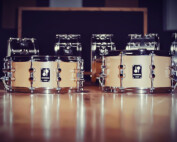
With such a history of success, what piece of advice can you pass on to the upcoming drummer? If you’re going to do it, do it properly. Spend time learning it, listen to older musicians to create something new and above all learn to play and perform ‘live’. If you can get into it and I repeat I am privileged, it’s a wonderful life. If you can have something else up your sleeve. I’ve seen so many musicians who have fallen by the wayside and I’ve been lucky that it hasn’t happened to me, but have something else to fall back on. If you’re going to be a musician then be one, don’t approach it half heartedly. If you love it that much, you’ll do it. Finally, what’s planned in your diary for 2012? The Earthband is back on the road early March for the rest of the year touring Europe including some dates in England in May. I’m also sitting in for Steve Ferrone with The Straits again including a gig at the O2 Indigo. I have my own band The Bad Apples featuring Micky Moody, Mick Rodgers, Robert Hart and Ian Jennings. We are recording an album at Riverside Studios in Bath, so there’s plenty going on. Endorsements: Drums: Tama For more information: www.jimmycopley.com |
I saw Jimmy Copley with UPP at Leeds Uni, opening for Beck, Bogert & Appice then later played the band's debut album to death. I remember Jimmy's open-handed approach very vividly, as do I the funky bassing of Stephen Amazing. The clip here (and others on YouTube) of the band with Jeff Beck suggests what could have been...and the 'She's a Woman' clip (YouTube) precipitates 'Blow by Blow' so you get a sense of how UPP influenced the direction of that album, though they didn't play on it (keys/vox man Andy Clark's co-write 'Head for Backstage Pass' appears of Beck's 'Wired'). Great to see Jimmy well, happy and gigging. 'Slap My Hand' is a wonderfully organic CD. A drummer who deserves a greater share of the spotlight.
Wayne Blanchard, 15 March 2012
Please log in below if you wish to add your comments on this item. If you are commenting for the first time, you will need to register for security reasons.
| SHARE | ||


.jpg)
In the 80’s and 90’s, I was in the studio almost every week and that’s when work was plentiful. The problem is that it is much easier and cheaper to make a CD in your front room rather than hire a studio and record with musicians